Lovable vs Bolt.new vs v0: Best AI App Builder in 2026?
Lovable, Bolt.new, and v0 compared on architecture, pricing, output quality, and security. Clear picks for founders, developers, and frontend teams.

Picking the wrong AI app builder doesn't just slow you down - it locks you into the wrong architecture, the wrong vendor, and the wrong cost model before your first user ever shows up.
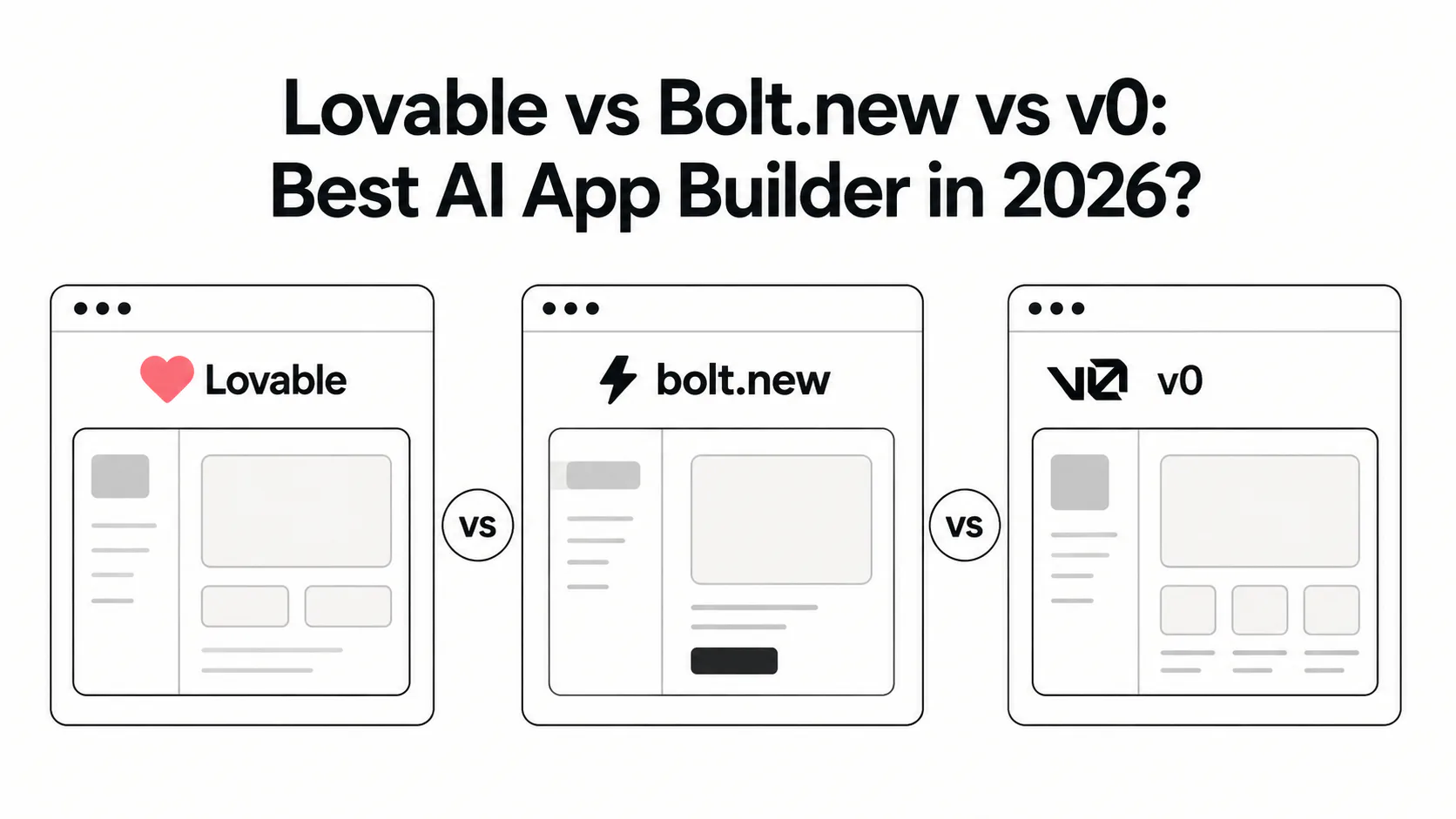
Lovable, Bolt.new, and v0 are the three tools everyone is comparing right now. They all generate applications from plain-English prompts. That's where the similarity ends.
This comparison is built from detailed technical analysis and real-world build data for all three platforms as of June 2026. Here's what actually separates them - and which one belongs in your workflow.
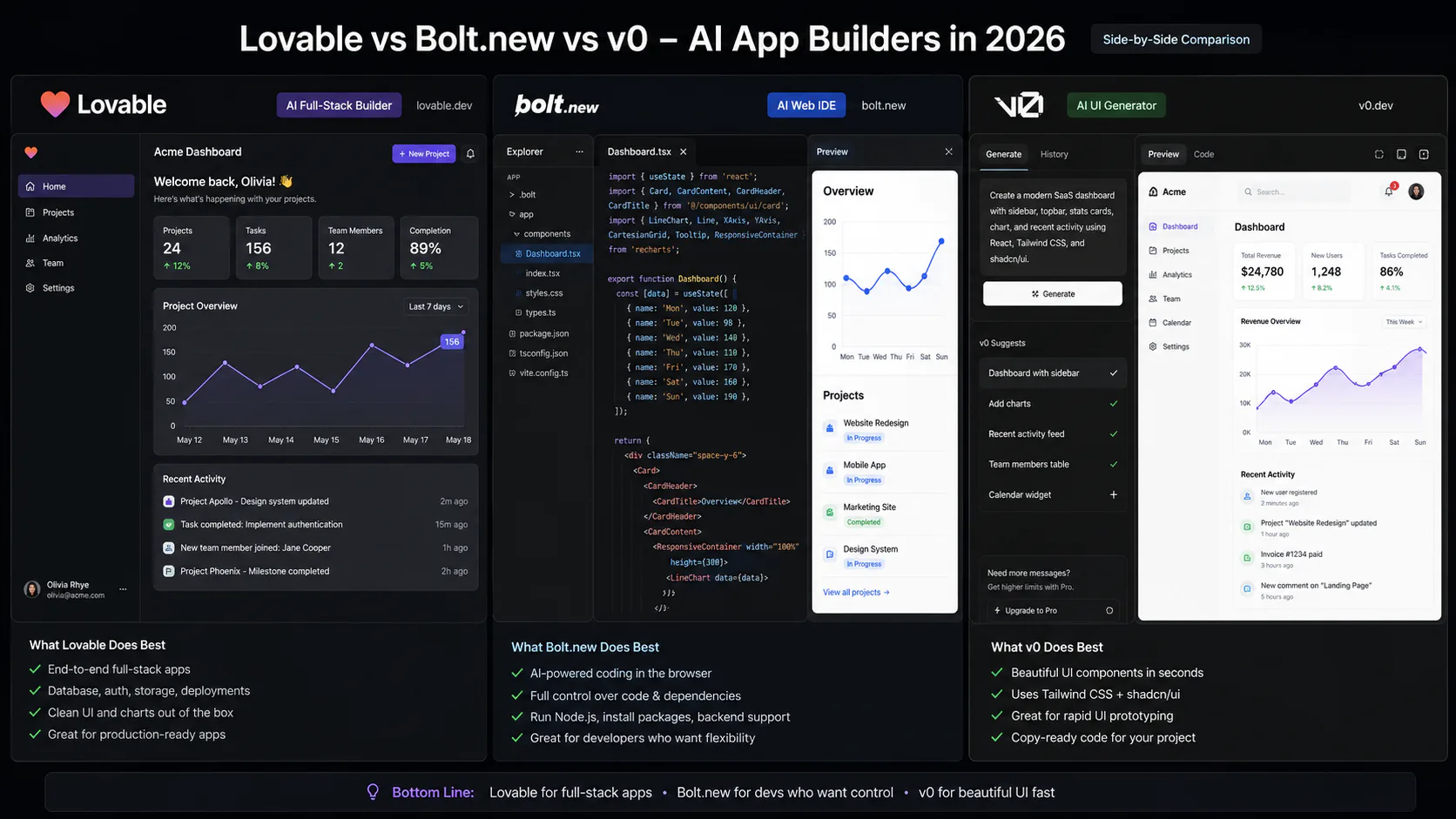
TL;DR: Lovable wins for non-technical founders who need a deployed full-stack app fast. Bolt.new wins for developers who want framework flexibility and code ownership. v0 wins for frontend developers building React components inside an existing Vercel project.
What these tools actually are (and aren't)
All three tools belong to the "vibe coding" category - a term coined by Andrej Karpathy in early 2025 that Collins Dictionary named Word of the Year for 2025. The idea: describe what you want in natural language, and an AI agent generates a working application.
The AI code generation market hit $4.2 billion in 2025. Enterprise adoption of vibe coding platforms grew 340% between 2024 and early 2026. Today, 41% of all code pushed to production globally is AI-generated (as of Q1 2026, per Hostinger's vibe coding statistics report).
But the category label hides three very different products.
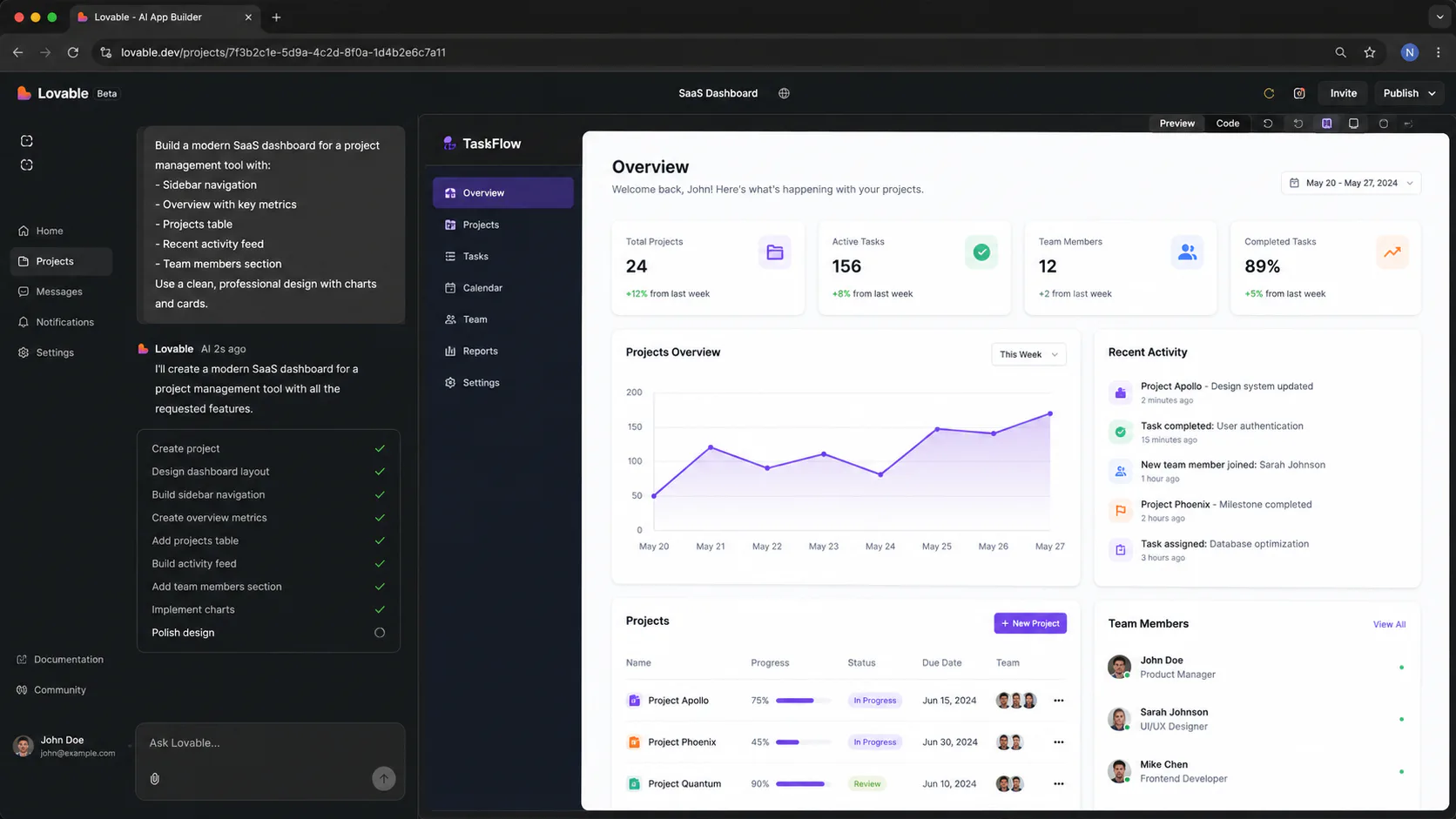
Lovable (formerly GPT-Engineer) is a managed full-stack builder. It provisions your frontend, backend, database, and hosting automatically. Non-technical founders can ship a real product without writing a line of code.
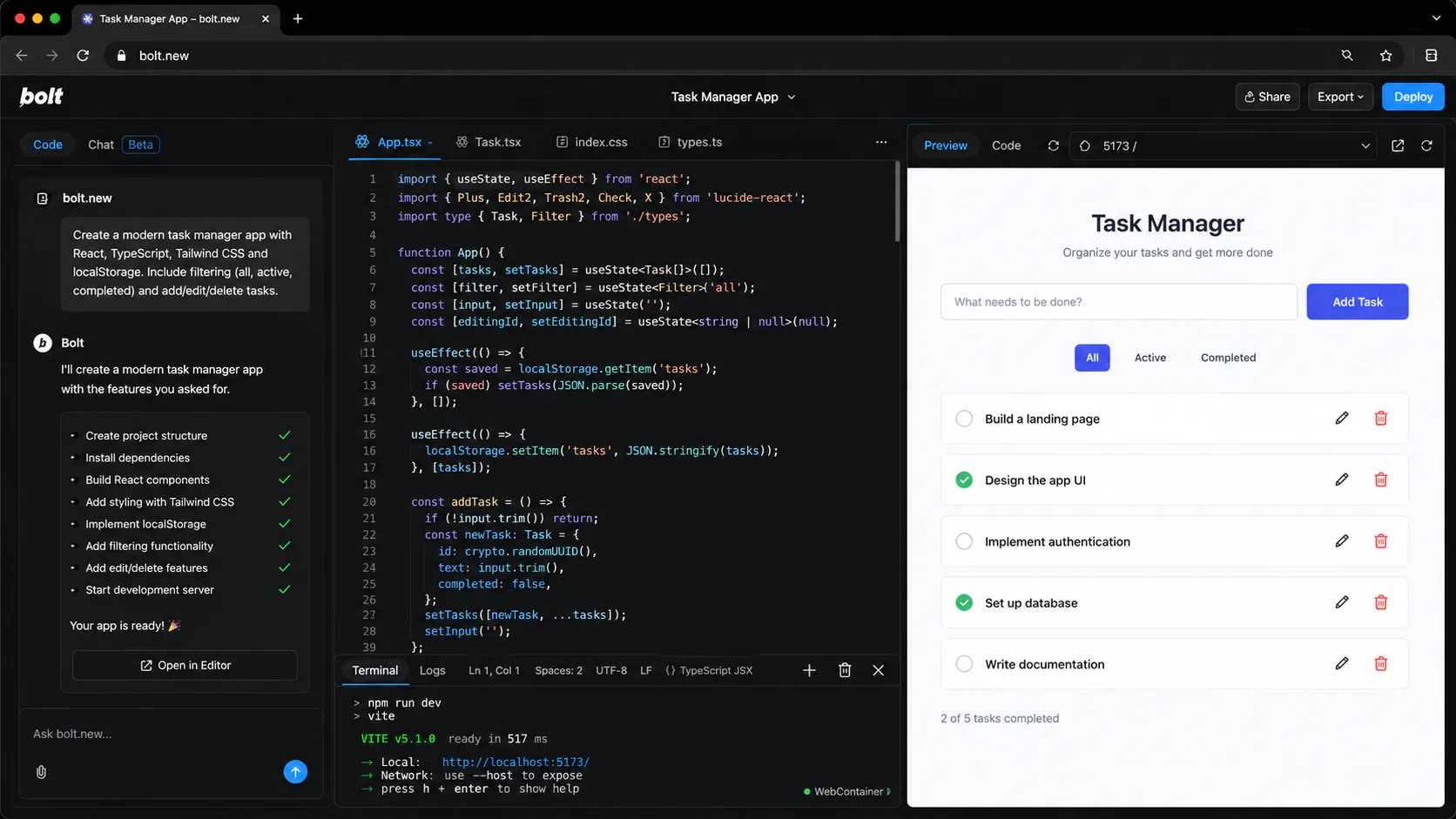
Bolt.new (by StackBlitz) is a browser-native development environment. It runs a full Node.js runtime inside your browser tab using WebAssembly - no local setup, no remote VM. It's built for developers who want to move fast without abandoning code ownership.
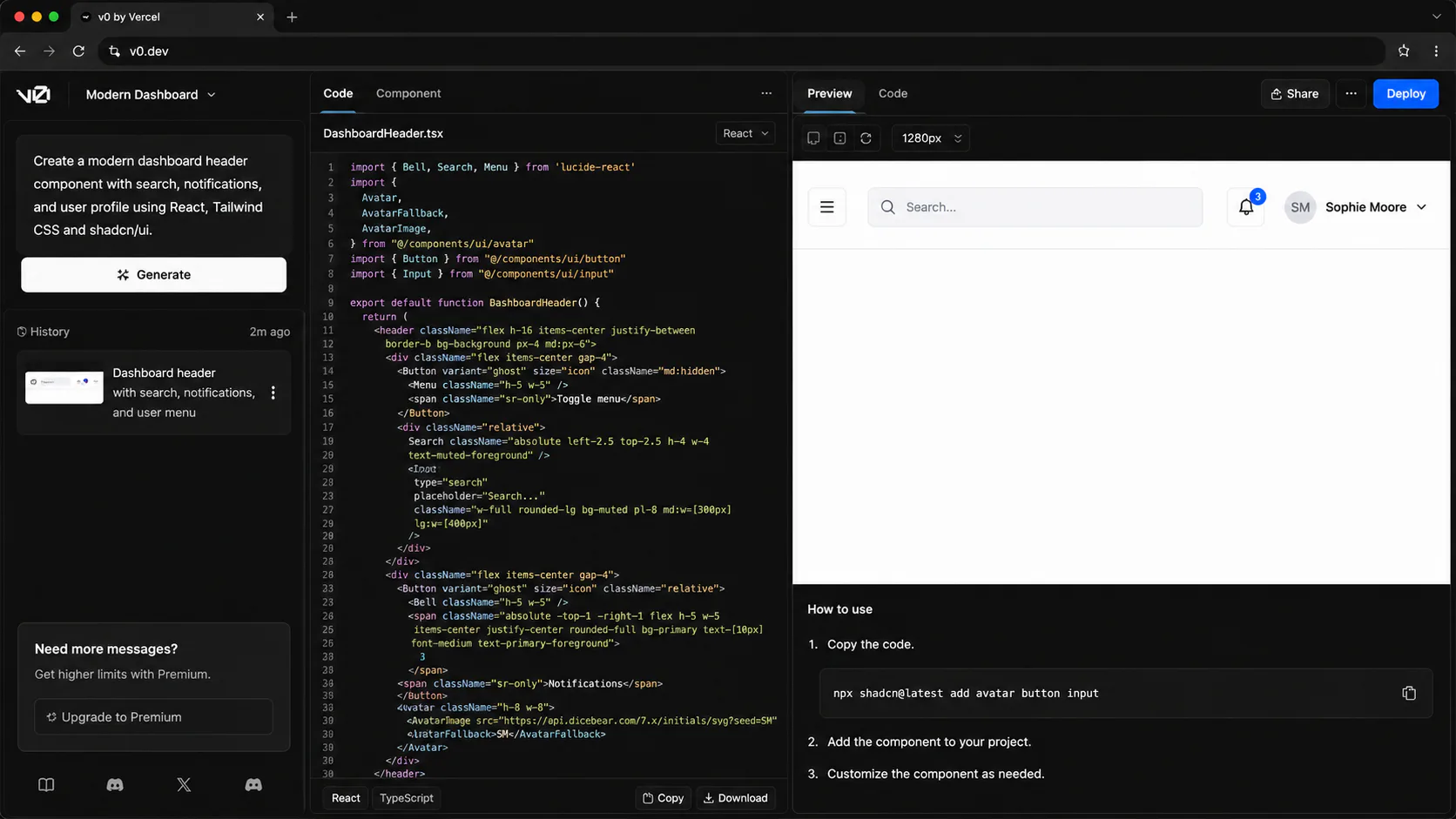
v0 (by Vercel) is a frontend component generator. It produces production-quality React, Tailwind CSS, and shadcn/ui code in 5–10 seconds per component. It's a power tool for frontend developers in the Vercel ecosystem - not a general-purpose app builder.
How each platform is built
Understanding the architecture tells you more than any feature list.
Lovable: managed infrastructure, invisible complexity
Every Lovable application runs on Supabase - PostgreSQL storage, Row Level Security for auth, and real-time updates - hosted on Lovable Cloud. You don't configure any of it. Lovable handles the stack end to end.
The benefit is real: a non-technical founder can deploy a full-stack app with auth and a working database in under ten minutes. A documented real case: a marketplace app with Supabase auth, Stripe integration, and polished UI, built in four hours for $25 total.
The constraint is equally real: that backend is Supabase, exclusively. If your requirements ever demand a different database, custom API layer, or on-premises storage, migration is a significant effort.
Bolt.new: Node.js in your browser tab
Bolt's core technology is StackBlitz's WebContainer - a system that uses WebAssembly to run a complete Node.js environment entirely in the browser. No remote VM. No installation. The environment boots in milliseconds and runs offline once loaded.
This matters in practice. You can start building in any browser on any machine with nothing installed. The generated code is live and editable in the same session that produced it. The environment is portable - any device, zero state transfer.
The trade-off: WebContainers can't run every native Node.js module. Packages with native C/C++ dependencies or platform-specific binaries may fail. This is a known ceiling, not a defect.
v0: purpose-built frontend models on Vercel infrastructure
v0 runs three proprietary AI models - Mini, Pro, and Max - fine-tuned specifically for React and frontend code generation. The output is React + Tailwind CSS + shadcn/ui: the exact stack that experienced Next.js developers write by hand.
Since February 2026, v0 also runs a full-stack sandbox that can import GitHub repositories and pull Vercel environment variables. It's expanding toward a complete development environment, but remains tightly coupled to the Vercel/Next.js world.
Feature comparison at a glance
| Feature | Lovable | Bolt.new | v0 |
|---|---|---|---|
| Non-technical user friendly | ✓ | Partial | ✗ |
| Full-stack app generation | ✓ | ✓ | Partial (2026) |
| Browser-native runtime | ✗ | ✓ | ✗ |
| Framework flexibility | ✗ (React) | ✓ (React, Vue, Svelte, Astro, Remix…) | ✗ (React/Next.js) |
| Built-in database | ✓ Supabase | ✗ (manual config) | ✗ (external) |
| Built-in hosting | ✓ Lovable Cloud | ✓ (Netlify, Vercel, Cloudflare) | ✓ Vercel |
| GitHub export | ✓ | ✓ | ✓ |
| Figma import | ✗ | ✓ | ✓ (Premium+) |
| Mobile app support | ✗ | ✓ (Expo) | ✗ |
| Open-source option | ✗ | ✓ (bolt.diy) | ✗ |
| AI model | Claude (Anthropic) | Claude (default) + others | Proprietary (Vercel) |
| Primary audience | Non-technical founders | Developers | Frontend developers |
Pricing: what you actually pay
Lovable pricing (mid-2026)
| Plan | Price | What you get |
|---|---|---|
| Free | $0 | Limited builds, Lovable subdomain |
| Starter | ~$20/month | Basic builds, custom domain |
| Pro | $25/month | 100 credits/month + 150 daily credits |
| Business | $50/month | Team collaboration, shared projects |
| Enterprise | Custom | Advanced integrations, dedicated support |
The Pro plan includes a $25/month Lovable Cloud hosting allowance. Complex builds cost extra: a simple game might cost $1 in credits; a complex application can exceed $50 in a single build session. Monthly costs are hard to predict for non-trivial projects.
Bolt.new pricing (as of May 2026)
| Plan | Price | What you get |
|---|---|---|
| Free | $0 | 1M tokens/month |
| Pro | $25/month | 26M tokens/month, token rollover (2 months) |
| Teams | $30/member/month | Shared workspace |
| Enterprise | Custom | SLAs, private deployment |
The free tier is the most generous of the three at 1 million tokens per month. Token rollover on Pro prevents waste from lighter months. That said, complex multi-file refactoring sessions can exhaust allocations faster than the numbers suggest.
v0 pricing (as of May 2026)
| Plan | Price | What you get |
|---|---|---|
| Free | $0 | $5/month in token credits |
| Premium | $20/month | $20/month credits + Figma import + API access |
| Team | $30/user/month | Shared credits, team management |
| Business | $100/user/month | Higher limits, advanced features |
| Enterprise | Custom | Custom pricing, SLA |
v0 switched from fixed credit counts to variable token-based pricing in February 2026. The Premium plan costs the same as before but the effective value per dollar is now task-dependent - a full-stack app generation can exhaust a month's credits in a few prompts. The $5 free tier is the tightest of the three and is really only sufficient for testing individual components.
Verify current pricing at lovable.dev, bolt.new, and v0.app before committing.
Output quality: what gets generated
This is where the tools diverge most sharply.
Lovable produces complete, deployed full-stack applications. The code runs, the database exists, and the auth works - immediately. The quality is sufficient for MVP validation and early production use. Because the code is abstracted during generation, non-technical users get a working product without needing to understand the implementation.
Bolt.new produces framework-flexible full-stack applications with immediate code access. A developer can read, edit, and take ownership of the generated code in the same session. Community feedback specifically praises Bolt's code transparency - it doesn't hide the implementation behind an abstraction layer.
v0 produces the highest per-component code quality of the three. Frontend developers consistently report that v0's output is "production-ready, accessible, responsive, and idiomatic" - and that they commit it directly to production codebases. The 5–10 second generation time enables high-volume iteration on component libraries and design systems.
A documented pattern shared across all three tools is the "1% finish problem": getting from 0% to 90% of an application is rapid. Getting from 90% to 100% - edge cases, precise behavior, production hardening - typically requires developer involvement that the AI alone can't complete through chat.
The security problem you can't ignore
This is the most important section in this comparison, and most comparisons underweight it.
Veracode's 2026 research found that 45% of AI-generated code contains security vulnerabilities. Stanford research puts exploitable vulnerabilities in AI-built applications at 80% or higher. An audit of 50 vibe-coded apps across all three platforms found that 88% had Supabase Row Level Security - the database mechanism that prevents one user from reading another user's data - completely disabled. Not misconfigured. Off.
This is invisible in demos and live previews. Which is exactly why it keeps happening.
Lovable's documented incidents in 2026 are the clearest illustration of the category-wide risk:
- A broken object-level authorization vulnerability in Lovable's API allowed any free-account user to access another user's source code and database credentials in five API calls. A researcher reported this on March 3. Lovable patched it for new projects, never fixed existing ones, and kept the ticket closed for 48 days before public disclosure.
- A Lovable-built app exposed 18,000 users due to misconfigured Supabase backend permissions.
The Moltbook incident - a vibe-coded platform that exposed 1.5 million API keys three days after launch due to a client-side exposure pattern all three AI builders are known to produce - is the most dramatic example of what happens when security review is skipped.
Risk by tool architecture:
- Highest risk: Lovable and Bolt, which generate the entire stack including auth and database configuration. The AI controls the full attack surface.
- Lower risk: v0, where the developer controls all architecture and security decisions and the AI generates only UI components.
Minimum governance requirements before deploying any AI-built app:
- Verify Supabase RLS is enabled and test it explicitly
- Run secret scanning (gitleaks or GitHub Advanced Security) on exported code before deploying
- Treat AI-generated code like code from an unvetted contractor: review before production
- Never deploy to production in fintech, healthcare, or applications handling children's data without a professional security review
Gartner warned in Q1 2026 that prompt-to-app approaches will increase software defects by 2,500% by 2028 without proper governance controls. This is the institutional version of what developer communities have been observing for a year.
When to use Lovable
Use Lovable if:
- You're a non-technical founder who needs a working full-stack product to validate a business idea
- You want to deploy something real - with auth, a database, and a hosted URL - without configuring infrastructure
- You need Stripe payments and Supabase auth out of the box
- Your timeline is hours, not weeks, and your budget is tight
Skip Lovable if:
- You need a backend other than Supabase - the lock-in is real and migration is costly
- You want to understand and own the generated code during development (export to GitHub is available, but it's a handoff step, not a live collaboration)
- You're building anything in fintech, healthcare, or apps handling sensitive user data without a dedicated security review budget
- Your project complexity is high enough that the per-credit cost of iteration will quickly exceed $50/month above the subscription
When to use Bolt.new
Use Bolt.new if:
- You're a developer who wants framework flexibility - React, Vue, Svelte, Astro, Remix - rather than a fixed stack
- You want to start from AI-generated scaffolding and take ownership of the code from minute one
- You're building a mobile app (Expo integration is unique to Bolt among the three)
- You want the most generous free tier for prototyping and hackathon use
- You want the option to self-host with your own AI model keys via bolt.diy
Skip Bolt.new if:
- You're non-technical and need a managed backend - manual Supabase configuration is a meaningful barrier
- Your project requires Node.js native modules with C/C++ dependencies, which WebContainers can't always handle
- You need the highest-quality frontend code output specifically - v0 wins on per-component React quality
When to use v0
Use v0 if:
- You're a frontend developer who needs production-quality React/Next.js/Tailwind components fast
- You're already in the Vercel and Next.js ecosystem with zero desire to configure another deployment target
- You need specific UI components for an existing project rather than a new application from scratch
- You need Figma-to-code conversion as part of your design-to-development workflow
- Code adherence to React best practices matters more than full-stack automation
Skip v0 if:
- You're non-technical - React component architecture is not optional knowledge here
- Your stack is Angular, Django, Ruby on Rails, or any non-Next.js backend
- You need a full application, not components - v0's full-stack additions in 2026 are still less mature than Lovable's or Bolt's
- Predictable monthly costs are important - token-based pricing since February 2026 makes per-task cost harder to forecast
Market context: who's winning and what's coming
Lovable is the commercial leader by a wide margin. The platform crossed $400M in annualized recurring revenue as of February 2026 (per Sacra estimates) - the fastest-growing European startup by ARR milestones - with a $330M Series B at a $6.6B valuation closed in December 2025. Over 25 million projects have been created on the platform.
Bolt.new hit $40M ARR by March 2025 and has not published updated revenue figures since. The platform retains significant developer loyalty, particularly for its open-source bolt.diy variant and WebContainer architecture. v0 serves over 6 million developers and is backed by Vercel, whose infrastructure budget gives it a runway independent of product revenue.
Google entered the market in 2026 with Stitch - a direct competitor to Lovable and v0 built on Gemini models with native Google Cloud deployment. A free, Google-subsidized alternative is already applying pricing pressure to all three standalone platforms. This is the same dynamic that drove consolidation in the CMS and analytics categories: platform companies subsidizing adjacent tools as user acquisition.
The clearest product trend is convergence toward full-stack. v0, which started as a component generator, added databases and Git in 2026. Lovable is adding multi-agent collaboration. All three platforms are moving toward more complete development environments - which will gradually reduce the differentiation that currently makes the choice obvious. The sustainable moats are ecosystem depth (Vercel for v0, Supabase for Lovable, WebContainer for Bolt) and enterprise distribution.
For deeper analysis of AI coding tools for developers, see our developer tools category and our Cursor 3 review for how professional developers use parallel AI agents in production workflows.
Final recommendation
Lovable is the right choice for non-technical founders who need a real deployed product fast, accept Supabase as the backend, and have budgeted for security review before going live with real user data.
Bolt.new is the right choice for developers who want framework flexibility, transparent code ownership, and the best free tier for rapid prototyping - and who have the technical background to configure their own backend.
v0 is the right choice if you're a frontend developer building React components inside an existing Vercel project, and you measure value by component output quality rather than full-stack coverage.
None of these tools is production-ready without a security review. Budget for one.
Frequently asked questions
Lovable is the clear choice for non-technical founders. It handles the full stack - frontend, database, auth, and hosting - automatically, and a working deployed app can be ready in under ten minutes from a good prompt. No coding knowledge is required. Bolt.new requires some technical background for backend configuration; v0 requires React knowledge to use the output meaningfully.
All three have free tiers. Bolt.new's is the most generous at 1 million tokens per month. v0's free tier provides $5/month in token credits - enough for testing single components but not for regular iterative development. Lovable's free tier allows limited builds hosted on a Lovable subdomain. All three require paid plans ($20–$25/month) for meaningful ongoing work.
Not without a security review. Research from 2026 found that 45% of AI-generated code contains security vulnerabilities, and 88% of vibe-coded apps audited had Supabase Row Level Security completely disabled. All three platforms generate code with this risk profile. Treat AI-generated applications like code from an unvetted contractor: run secret scanning, verify RLS is enabled, and conduct a security review before going live with real user data.
v0 by Vercel generates the highest-quality React/Tailwind/shadcn-ui component code of the three. Frontend developers consistently report committing v0 output directly to production codebases. If you need a complete application rather than individual components, Lovable and Bolt.new are more appropriate - but their per-component code quality is generally lower than v0's.
Google Stitch (2026) is a subsidized full-stack competitor built on Gemini with native Google Cloud deployment. It pressures pricing on standalone builders but is newer and less proven for non-technical founders than Lovable's Supabase-backed workflow. Developers already on Vercel may still prefer v0; teams wanting open export paths often stay with Bolt.new or Lovable's GitHub sync.